The Emoyeni Group’s Gulfstream G650 touched down in Durban in the humid, thick heat of the KwaZulu-Natal coast. The air felt heavy, charged with political tension and the smell of the Indian Ocean.
In the back of the jet, the atmosphere was frozen. Tsholo, Zweli’s half-sister, sat across the aisle from the couple. She was sleek and predatory, dressed in linen that cost more than Beauty’s car.
“I’ve booked us into the Oyster Box, Zweli,” Tsholo announced, not looking up from her tablet. “The meeting with Minister Zuma is at 15:00 at his office in the Department of Logistics. Remember, this is not a construction pitch. This is a subtle dance of power.”
“We understand the stakes,” Beauty said firmly, adjusting the collar of her silk blouse. She was wearing her “armour” now, a white suit that radiated confidence.
“Do you, Mrs Masilela?” Tsholo sneered, finally looking up. “The Minister is an old-school politician. He is arrogant, chauvinistic, and wants flattery, not spreadsheets. Your job, Zweli, is to keep her quiet. She has the smell of debt and desperation. Let me handle the conversation. I’ve known Minister Zuma since he chaired the Youth League.”
Zweli’s hand rested on Beauty’s knee, a silent pressure. He was reminding her of the battle plan they had discussed in the kitchenette: Silence is golden, until they underestimate you.
“Beauty is the CEO of the construction firm handling the ground logistics,” Zweli stated calmly. “She speaks when necessary.”
Tsholo scoffed. “If necessary, I’ll use the family’s legal team to sideline her. Don’t test me, brother.”
Department of Logistics: Minister’s Office – 15:00
The office was overly ornate, decorated with dark leather and heavy portraits of historical figures. A uniformed guard stood by the door.
Minister Bheki Zuma was a thick-set man with a dismissive air. He sat behind an enormous wooden desk, looking bored.
“Ah, the Masilelas,” the Minister said, not rising. “The Lion sends his youngest. And the daughter.” He glanced at Tsholo.
“Good afternoon, Minister,” Tsholo purred, taking the centre seat and leaning forward. “This is my half-brother, Zweli, and his… associate, Mrs Masilela. We are here to finalise the Durban-Inland Logistics Corridor.”
She slid a sleek, gold-embossed presentation folder across the desk. “Emoyeni has restructured the financing. We have secured the guarantee. The R8 billion tender needs only your signature on the feasibility waiver.”
The Minister ignored the folder. He leaned back and linked his hands over his stomach.
“The Corridor is vital for the province,” the Minister said slowly. “But I have concerns. Emoyeni is a Cape Town empire. Why should I trust a Gauteng company to build my infrastructure?”
“We are South African, Minister,” Tsholo replied smoothly. “And we offer the best tender.”
“The best tender means nothing without political certainty,” the Minister said, his eyes finally drifting to Beauty. “The current construction sector is… problematic. Too much noise. Too many complaints about local procurement. And I hear your associate here ran a small firm that was almost bankrupt.”
Beauty felt the insult like a punch. She saw Tsholo subtly shake her head—Don’t engage.
“Minister,” Beauty said, her voice cutting through the humidity. She ignored Tsholo’s glare. “Shongwe Enterprises wasn’t bankrupt. It was asset-rich and cash-flow poor—a common issue for ethical contractors fighting cartels. We fought off the same syndicate that has been rigging municipal tenders for years.”
The Minister raised an eyebrow, amused. “A fighter, hey? And who won that fight?”
“I did,” Beauty stated firmly. “And now that Emoyeni’s capital backs Shongwe Enterprises, we can ensure 100% local procurement, employ two thousand local workers, and finish the project six months ahead of schedule. We have the ethics and the drive you need, Minister. Not just the cash.”
The Minister stopped smiling. He studied Beauty. He saw a conviction that transcended boardroom politics.
“Local procurement is good,” the Minister conceded. “But this project is vital. It needs a guarantee.” He leaned forward, dropping his voice. “Emoyeni has been in my province for years, but the support for local initiatives has been… lacking. The Minister’s Charitable Fund, for instance, needs a massive injection.”
The demand was clear: R50 million bribe.
Tsholo immediately took over, her voice hardening. “Minister, we cannot discuss informal funding without documentation. Emoyeni follows the letter of the law.”
The Minister laughed—a harsh, barking sound. “Then there is no deal, Miss Masilela. I was hoping you could bring me a company that understands the rules of the game. Get out.”
Tsholo stood up, furious. “This is extortion!”
“This is governance,” the Minister corrected. “And I don’t respond well to threats. You have twenty-four hours to change your mind. Or the tender goes to the Chinese firm.”
Tsholo grabbed her folder and marched to the door. “We’re leaving, Zweli.”
The Hallway
Tsholo was livid. “You ruined it!” she hissed at Zweli. “You let the township girl talk! He hates being lectured by women, inferior ones! You were supposed to control her!”
“I controlled myself,” Zweli said, his face a mask of disappointment. He was watching his inheritance slip away.
Beauty stood apart, her face flushed with anger. “He asked for a bribe, Zweli. Tsholo would have signed the paperwork for a payoff.”
“Of course, I would!” Tsholo cried. “It’s the cost of doing business! You think Daddy’s money is clean? We needed this win, Zweli! Now, we have twenty-four hours to produce an extra R50 million that can be laundered through some charity! Do you have a solution, CEO?”
Zweli closed his eyes. He had the money. He could wire R50 million through one of his ghost firms in the Cayman Islands immediately. But that would compromise the “clean slate” his father needed, and betray Beauty’s ethical stance.
Zweli, use your weapon, Beauty had whispered during their argument. Not your wallet.
Zweli opened his eyes. He looked at the Minister’s closed door.
“Tsholo, go to the hotel,” Zweli ordered. “Wait for my call. Beauty, you are coming with me.”
“Where are we going?” Beauty asked, confused.
“To find the weapon that Minister Zuma doesn’t know I have,” Zweli said.
Durban Port: 18:00
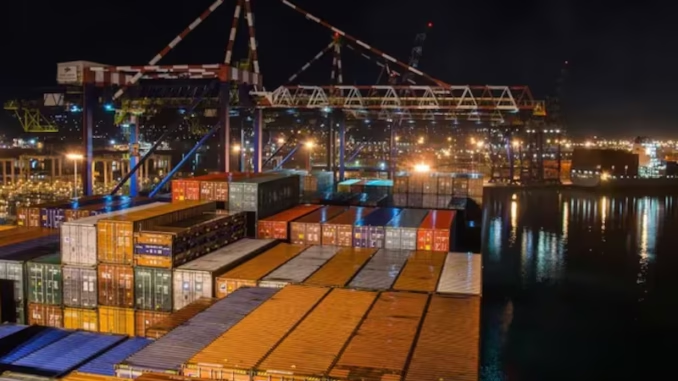
Zweli drove the rented SUV straight to the Durban port. The massive container yard was dark and busy, dominated by the silhouette of cranes.
He drove past a section of the yard that was heavily guarded by private security.
“That’s the contraband section,” Beauty noted, staring at the high razor-wire fence. “Seized goods.”
Zweli stopped the car. He picked up his secure phone and called Comfort Sindane in Pretoria.
“Comfort, I need the details on the Nigerian Brotherhood’s activity in the Durban Port area. Specifically, any recent high-value seizures in the last six months.”
A minute later, Comfort’s voice came back. “Ah, Sir. The customs ledger shows a massive shipment of counterfeit electronic goods—smartphones and laptops—seized two weeks ago. Estimated value: R90 million. The owner is listed as ‘Bayview Logistics.'”
“Bayview Logistics,” Zweli repeated. “That company is a known front for the Nigerian Brotherhood. The group that Darius hired.”
“Correct, Sir. And guess who owns the primary warehouse Bayview Logistics was using in the Durban Free Trade Zone? Minister Bheki Zuma’s wife. She leased it to them for R1 a month.”
Beauty gasped. “The Minister is tied to the syndicate that tried to kill us!”
“He’s not tied; he’s profiting,” Zweli corrected. “Darius’s contingency was to use his connections to cripple my father’s tender. He’s squeezing us through organised crime. And that makes him a target.”
Zweli looked at the heavily guarded container yard. “The counterfeit goods are evidence. If that evidence disappears, the Minister is safe. If it gets leaked to the press, he goes down.”
“So we leak it,” Beauty said, reaching for her phone.
“No,” Zweli said. “Leak it, and the tender is dead. We need the tender. We need the leverage.”
Zweli turned to Beauty. “I need you to get me past those guards, Beauty. Use the ‘CEO’ voice. Tell them we are performing an emergency night audit on behalf of the Emoyeni Group.”
Beauty swallowed, looking at the grim-faced guards. “And then what?”
“Then,” Zweli said, pulling a pair of thin leather gloves from his pocket, “I use the ‘Unseen King’ hands to find the container, and you use the ‘CEO’ brain to find the documents that link it to Zuma.”
The Seized Goods Yard: 20:00
Beauty stood at the gate, radiating authority. “I am CEO Beauty Masilela,” she announced to the head guard. “Emoyeni Group. We have credible intelligence that evidence is about to be compromised. Call your supervisor; we are taking inventory now.”
The guard, intimidated by the luxury SUV and Beauty’s demanding tone, reluctantly let them in.
Zweli led her through the maze of towering containers. He wasn’t using a map. He was using instinct. He moved with a focused, silent grace, like water flowing through concrete. He stopped in front of a container marked BLX-901.
“This is it,” Zweli said. “The container of counterfeit goods.”
“How do you know?”
“I heard the rhythm of the security patrols outside,” Zweli said. “This corner is the blind spot. This is the valuable one.”
He pulled a small, complex tool from his jacket pocket—not a typical picklock, but a specialised magnetic resonator. He worked quickly, his fingers a blur.
Click. The container door opened.
Inside, crates of smart devices were stacked high. Beauty immediately spotted a file box near the front.
“The manifest!” Beauty snatched the box. “It’s all here. The paper trail that connects Bayview Logistics to Zuma’s wife.”
“Good,” Zweli said, taking photos of the documents with his phone. “Now, we leave.”
As they turned to exit the narrow corridor between the containers, a sound echoed from the far end.
“Stop right there!”
Two men in black tracksuits, clearly not port security, emerged. They held crowbars.
“The Nigerian Brotherhood sends its regards,” the leader sneered. “Darius told us you might come looking. Now, the goods disappear, and you disappear with them.”
They advanced, crowbars raised.
Beauty gasped, instinctively hiding the evidence box behind her back.
Zweli calmly stepped in front of her. The suit, the subtle wealth, the polished facade—it vanished. He was the Dragon.
“Go back to Lagos,” Zweli said, his voice a dangerous whisper. “You are trespassing.”
The men rushed him.
The fight was fast, brutal, and silent. Zweli didn’t need a sledgehammer. He used the container walls. He caught the first crowbar, twisted it out of the man’s hand, and used it to slam the second man into the steel wall with a deafening CLANG. He used the man’s momentum against him, ending the fight in ten seconds.
Zweli leaned against the container, breathing heavily. He looked at Beauty, who was staring at the crumpled bodies.
“Let’s go,” he said. “The police will be here in three minutes.”
Minister’s Office: 08:00 AM (Next Morning)
Zweli and Beauty were the first ones through the Minister’s door. Tsholo arrived five minutes later, still trying to smooth her hair.
Minister Bheki Zuma looked tired. He had a copy of the Daily News open on his desk, his face grim.
“Good morning, Minister,” Beauty said, placing the folder of Emoyeni documents on his desk. “We are here for the signing.”
“The offer is off the table,” the Minister growled. “I don’t deal with insolent children who refuse to be bought.”
“We weren’t refusing to be bought, Minister,” Zweli cut in, leaning over the desk. “We were refusing to pay the wrong price.”
Zweli then slid a single envelope across the desk. Inside was a high-resolution photograph of the manifest from the BLX-901 container, clearly showing the Minister’s wife’s company logo.
“We have this, Minister,” Zweli said softly. “The papers that link the Bayview Syndicate to your wife. It proves that the same criminal element that nearly blew up the Voortrekker Monument is profiting under your nose.”
The Minister stared at the photo. His chest rose and fell rapidly.
“The R50 million bribe,” Zweli continued, “was a trap, wasn’t it? To make Emoyeni look corrupt so that you could give the tender to a clean Chinese firm. But you aren’t clean.”
“What do you want?” the Minister rasped, defeated.
“No bribe,” Beauty said, stepping forward. “Just the tender. And the promise that you will fully cooperate with the National Crime Agency in dismantling the Bayview Syndicate. We are not just building a railway, Minister. We are cleaning up your province. Starting with your office.”
The Minister looked at the photograph, then at Beauty. He saw the fire. He saw the power.
He reached for the R8 billion tender document. His hand was shaking. He didn’t look at Tsholo, who was slack-jawed in the corner. He looked at the woman who had fought his war for him.
He signed it.
2 Trackbacks / Pingbacks